Long-Horizon Flow
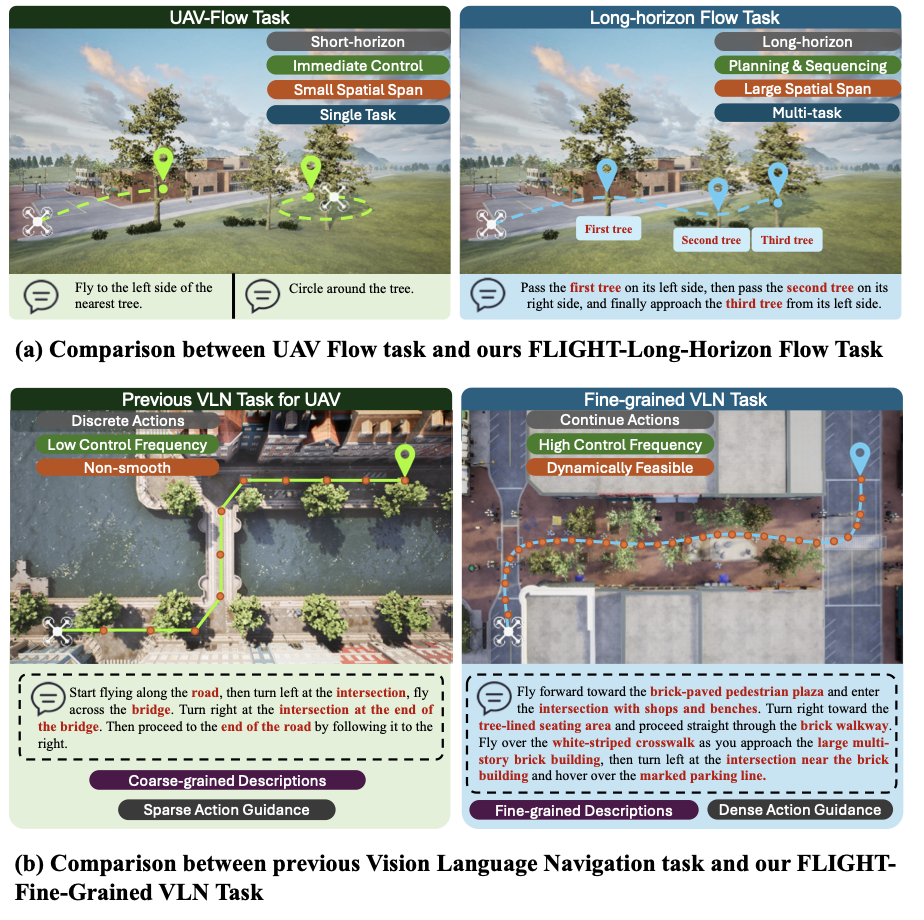
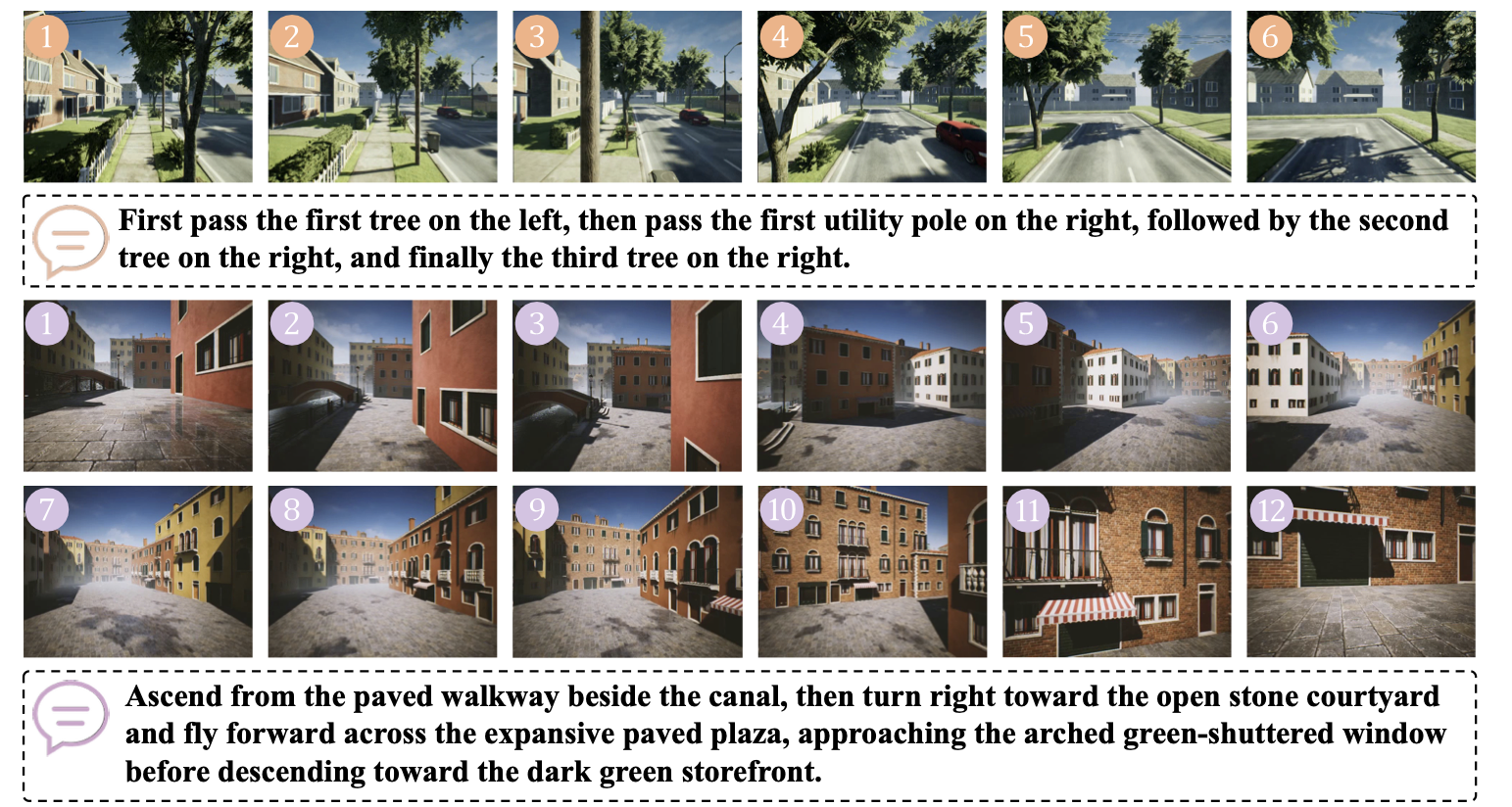
Extends atomic UAV-Flow instructions into compositional missions that combine traversal, translation, approach, orbiting, takeoff, landing, and task termination.
Colab, Beihang University · Meituan · National University of Singapore
We introduce FLIGHT, a Fine-grained Long-horizon Instruction-Guided benchmark for Hybrid UAV navigation and reasoning Tasks, together with FLIGHT VLA, an asynchronous fast–slow framework for UAV agents that must follow multi-stage language instructions while producing smooth, physically feasible continuous flight commands.
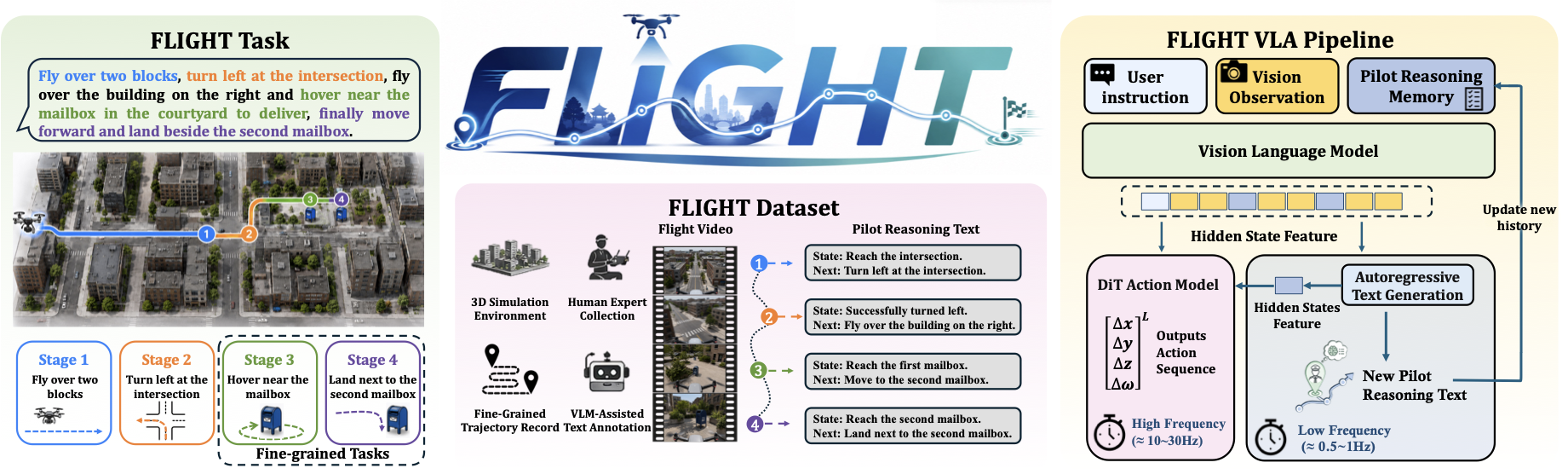
FLIGHT closes the gap between long-range VLN and fine-grained UAV VLA tasks by combining multi-stage semantic missions with dense 6-DoF trajectory supervision.
Extends atomic UAV-Flow instructions into compositional missions that combine traversal, translation, approach, orbiting, takeoff, landing, and task termination.
Recasts visual-language navigation with dense landmark grounding and continuous action sequences instead of sparse discrete navigation decisions.
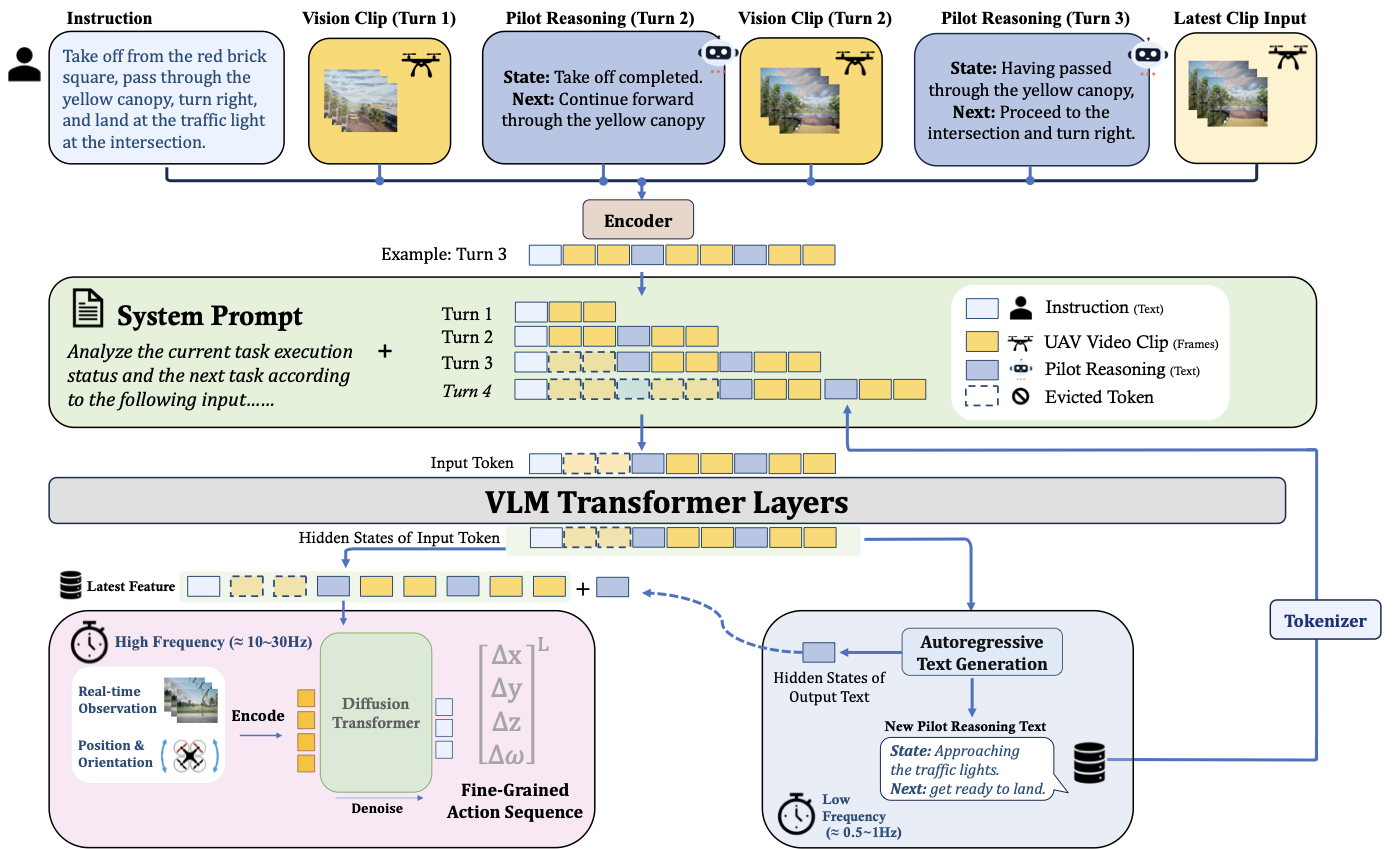
Adds textual supervision that summarizes the current flight state and anticipates the next subgoal, giving VLMs an explicit task-progress signal.
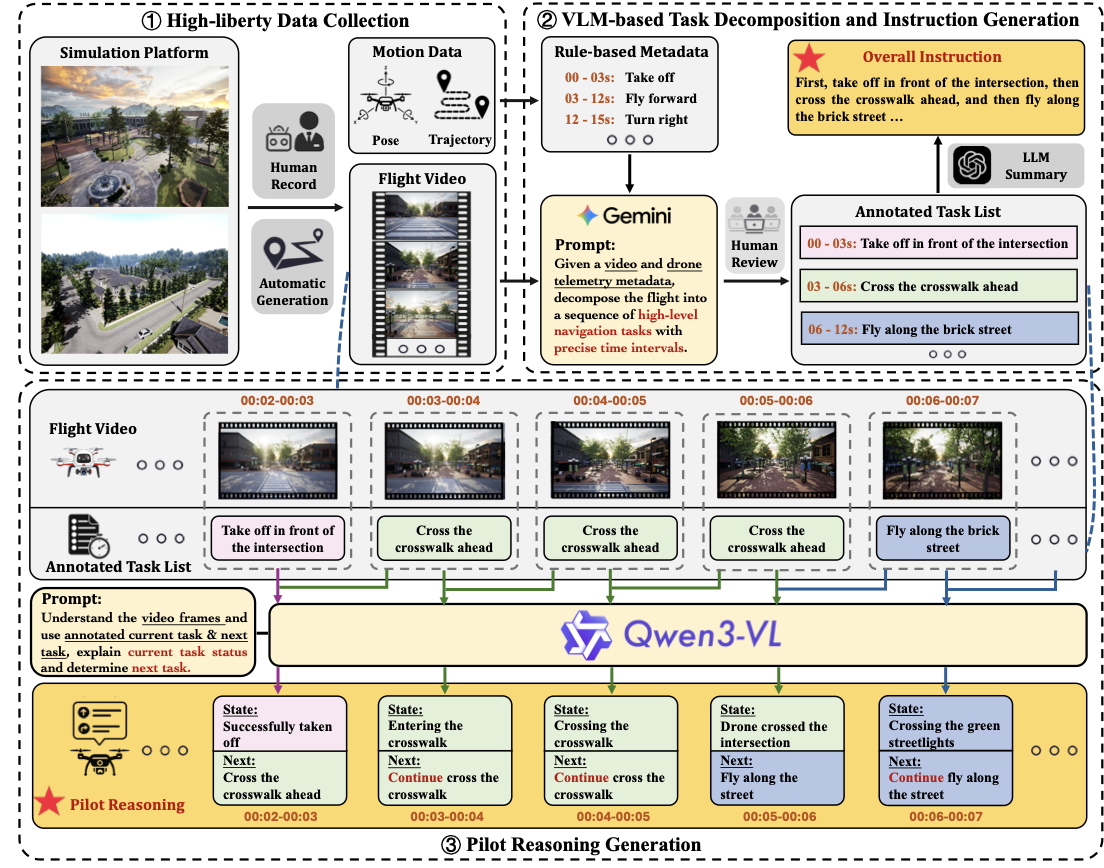
Demonstrations are collected in semantically rich Unrealzoo simulation scenes, aligned with FPV video, UAV state, 6-DoF pose, task semantics, and reasoning texts.
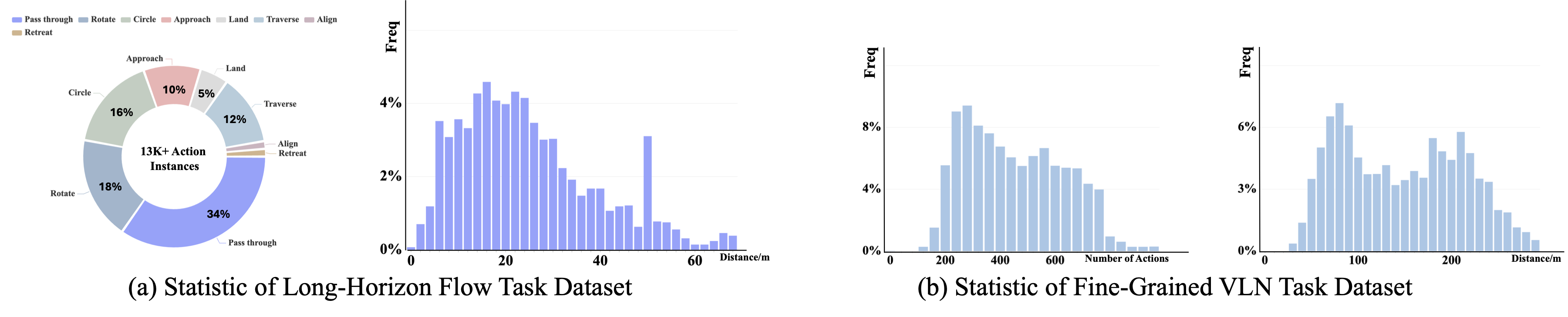
Average trajectory length of 154.5 m with continuous actions sampled at 10 Hz.
13,815 action instances with an average of 3.37 subtasks per trajectory.
Records position and attitude, then converts adjacent states into relative motion commands.
Human pilots and simple-route planners produce expert UAV trajectories and aligned first-person flight videos.
Motion metadata and segmented video clips guide VLM annotation of task semantics at fine temporal granularity.
Pilot Reasoning texts are generated from current and next-step task semantics, then verified for planning consistency.
FLIGHT VLA decouples a low-frequency Streaming Pilot VLM from a high-frequency diffusion action model, allowing long-context reasoning and responsive closed-loop control to coexist.
Consumes recent FPV video, UAV state, task instruction, and historical Pilot Reasoning memory to infer task progress and next-step plans.
Uses real-time visual features, relative UAV state, and the latest semantic feature to generate fine-grained future action chunks.
FLIGHT VLA improves multi-stage task completion, subgoal adherence, terminal control, and UAV video reasoning over representative VLA and VLN baselines.
| Long-Horizon Flow | SR | SSR | NDTW |
|---|---|---|---|
| OpenVLA-UAV | 10.50 | 30.87 | 18.02 |
| Memory VLA | 18.50 | 38.69 | 16.58 |
| FLIGHT VLA | 59.00 | 78.97 | 45.78 |
| Fine-Grained VLN | SR | OSR | NE | IASR |
|---|---|---|---|---|
| CMA+LAG | 6.5 | 22.0 | 52.56 | 4.5 |
| NaVid | 13.0 | 25.5 | 46.69 | 5.0 |
| FLIGHT VLA | 13.5 | 37.0 | 45.52 | 11.0 |
All metric values are reported as percentages except NE, which is measured in meters.
Please cite FLIGHT if this benchmark, dataset, or framework supports your research.
@misc{zheng2026flight,
  title         = {Think Like a Pilot: Fine-Grained Long-Horizon UAV Navigation},
  author        = {Zheng, Xiangyi and Wang, Xiangyu and Liao, Qinan and Tang, Zimu and Liao, Yue and Lyu, Dongyue and Wang, Guodong and Liu, Junjie and Liu, Si},
  year          = {2026},
  eprint        = {2606.06836},
  archivePrefix = {arXiv},
  primaryClass  = {cs.RO},
  url           = {https://arxiv.org/abs/2606.06836}
}