EMNLP 2026 Main Conference
TRACE
Temporal Retrieval with Anchored and Convergent Evidence for Long-Horizon Video Understanding
1 Beihang University 2 Peking University 3 Shanghai AI Laboratory
* Equal contribution. † Corresponding author.
A long-video answer is evidence-supported only when the frames decoded from the video cover every event the answer depends on. Scoring the answer alone cannot tell the difference.
01 The gap between answering and observing
Existing long-video evaluations score final-answer correctness, or they score the evidence intervals a method predicts. Neither audits the frames the method actually decoded before it answered, so a correct answer can still rest on incomplete observation.
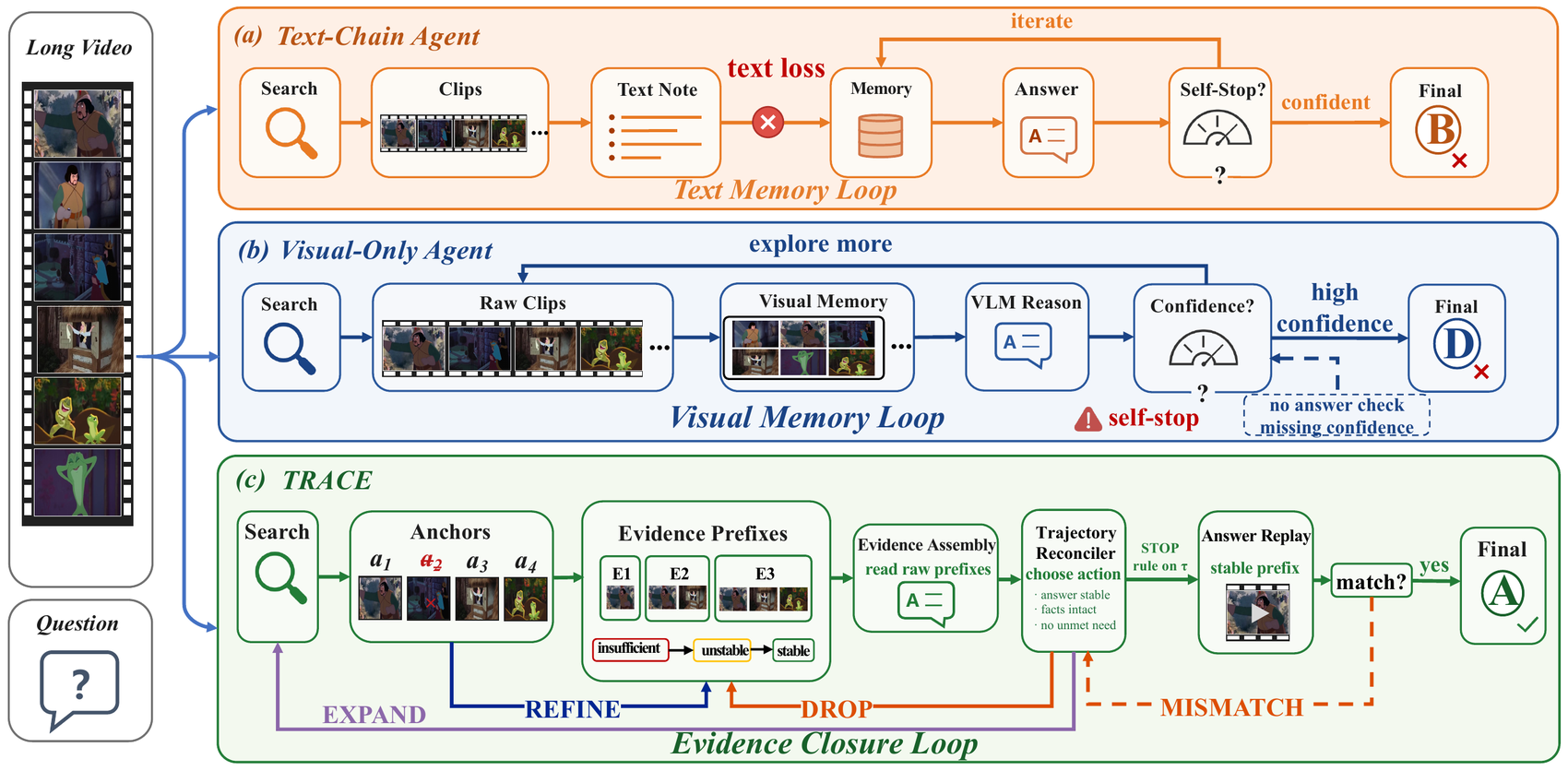
Two failure patterns recur in agent-based methods. Text-chain agents accumulate evidence as a textual rationale across rounds and lose visual grounding. Visual-only agents keep the raw clips but stop on a self-reported confidence check, and a wrong stop either leaves required intervals unseen or spends the budget on confounding ones.
02 VES-Bench, and what makes a question auditable
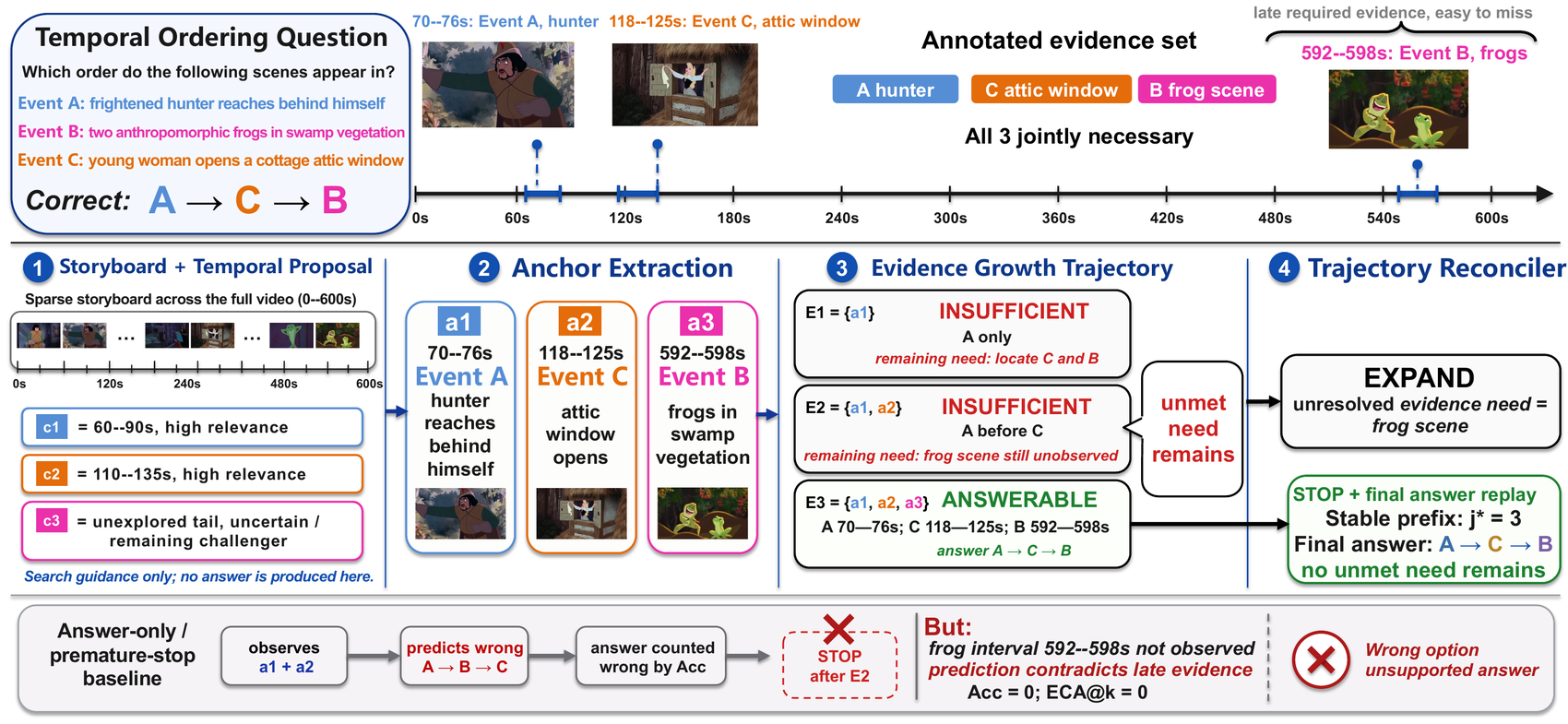
A question is evidence-closed when it comes with an evidence set whose intervals are jointly necessary: remove any one of them and at least two answer options stay visually compatible with what is left. That property is what makes coverage auditable rather than decorative.
- Scale
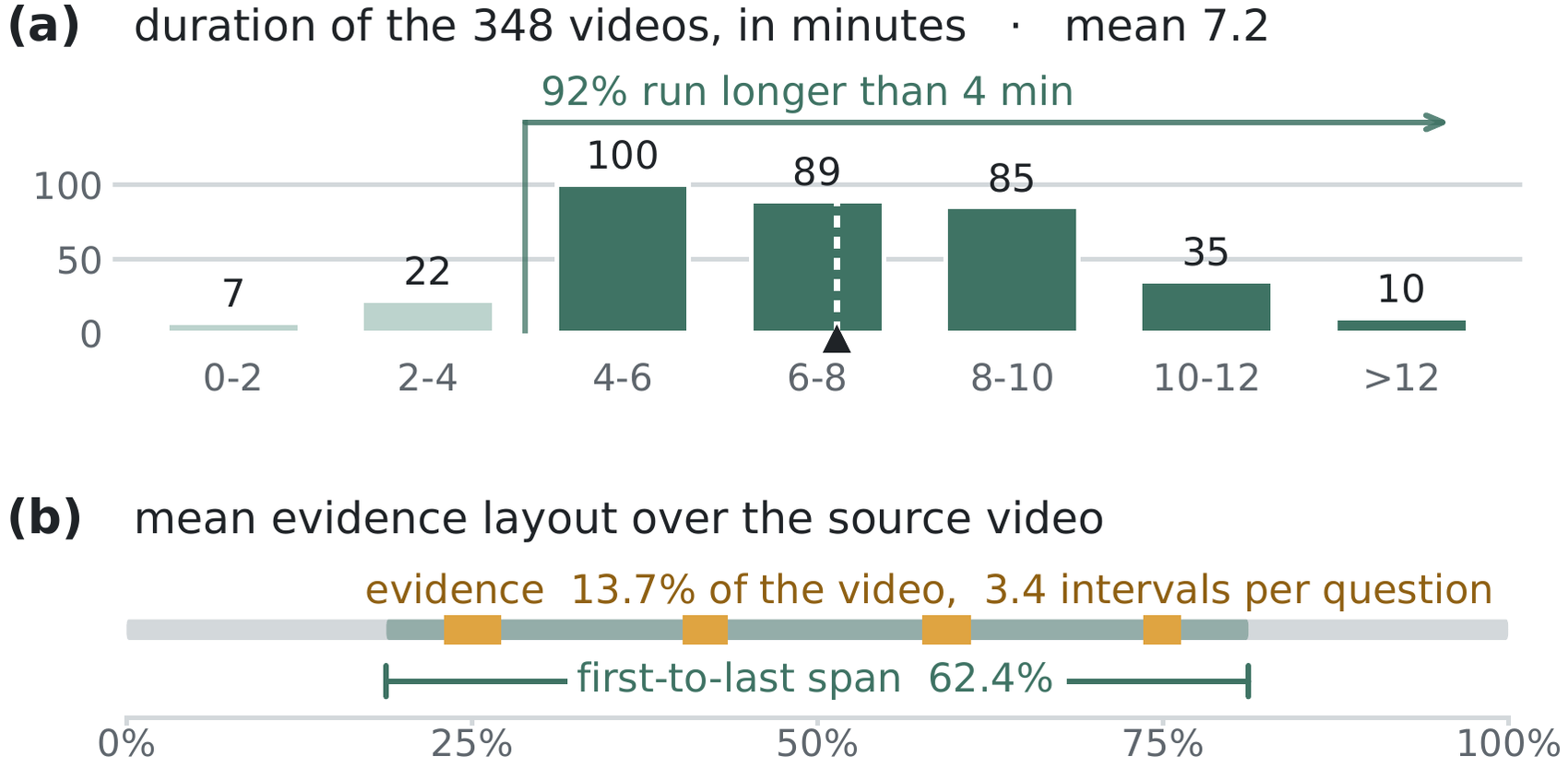
- 600 four-choice questions over 348 public Ego4D and YouTube videos, split evenly between Temporal Ordering and Event Counting.
- Evidence layout
- The average video runs 434 seconds. An average question carries 3.4 evidence intervals of 16.2 seconds each.
- Selection
- A five-stage pipeline with visual verification, a leave-one-out sufficiency probe, and a language-only shortcut probe. A pool of 1,024 candidates yields the 600 accepted items.
- Audit metrics
- Targeting by evidence precision EP and allocation ratio AR, breadth by Cov@k, and the two coupled as ECA@k at strictness k of 1, 2, and 3.
03 Anchored evidence, and a stopping rule you can check
TRACE is training-free. It organises long-horizon evidence as visual anchors, keeps the raw clips rather than their summaries, and grows an evidence bundle round by round. Evidence counts as convergent when later anchors no longer change the answer, no longer degrade answerability, no longer contradict discriminative facts, and leave no remaining evidence need.
Stopping is therefore a property of the bundle instead of a confidence report. TRACE stops when a minimal stable prefix exists and a final pass over the same clips returns the same answer.
- STOP
- A minimal stable prefix exists: later anchors change neither its answer nor its supported facts, and it has no unmet evidence need.
- DROP
- Some anchors introduce noise, conflict, or misleading local evidence, so they are removed and the trajectory is rebuilt.
- REFINE
- An observed interval is relevant but lacks temporal or spatial detail, so it is reobserved with a more suitable strategy.
- EXPAND
- The bundle lacks events, states, or identity cues that may affect the answer, so candidates from unexplored segments are introduced.
04 The audit
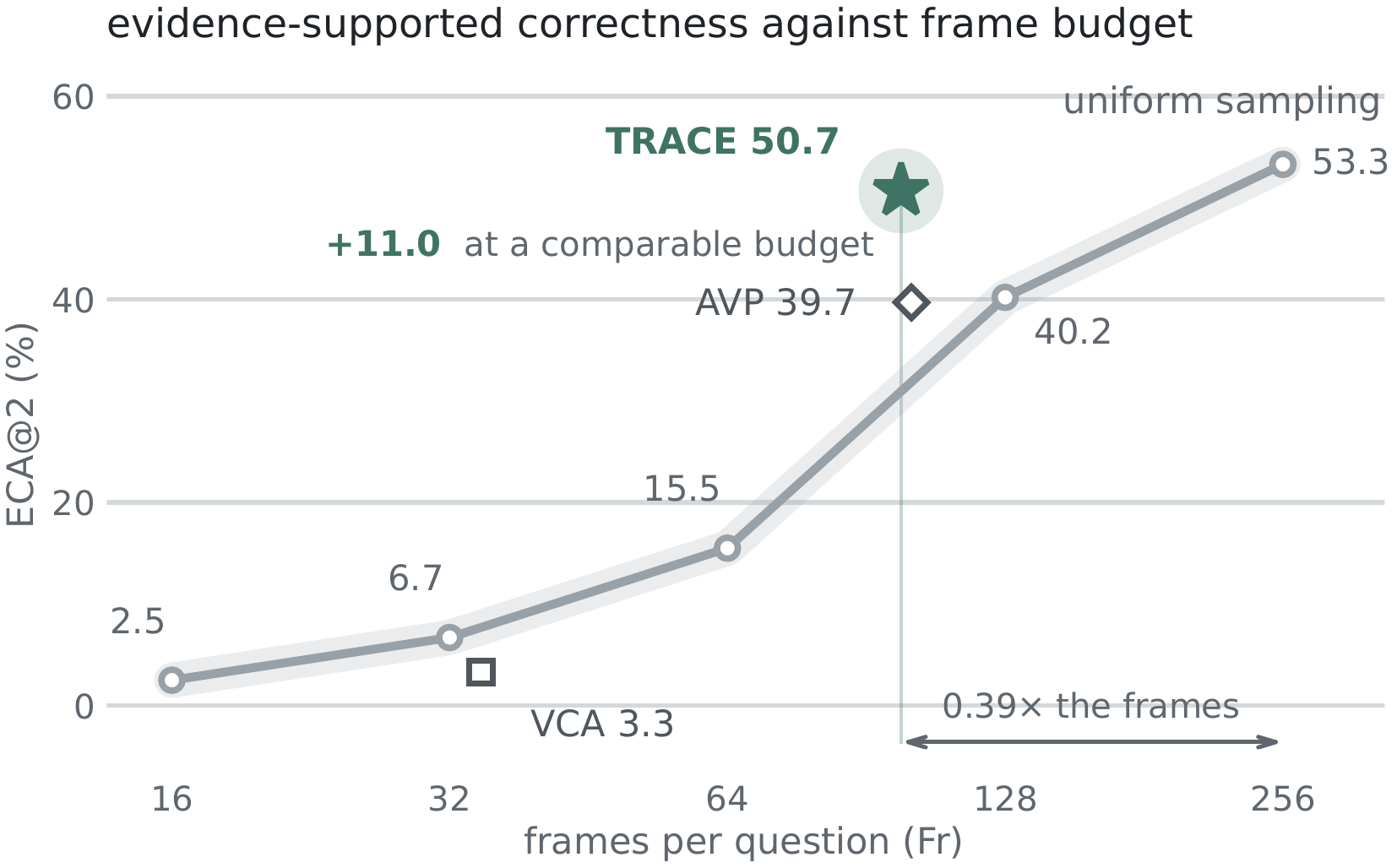
Every row is a method paired with a frame budget. EPref is fixed by the benchmark at 13.7 percent, computed once from the 348 video durations and the 600 evidence sets, so any sampler placing frames uniformly in time lands at AR near 1.00 by construction. Strictness k equals 2 is shown here; the paper reports k of 1 and 3 as sensitivity bounds.
| Method | Fr | Acc | EP | AR | Cov@2 | ECA@2 |
|---|---|---|---|---|---|---|
| Non-visual baselines | ||||||
| Random | 0 | 25.0 | - | - | - | 0.0 |
| Blind GPT-4-Turbo | 0 | 25.3 | - | - | - | 0.0 |
| Same-backbone uniform sweep, Gemini-3-Flash | ||||||
| Uniform-16 | 16 | 35.3 | 13.7 | 1.00 | 4.0 | 2.5 |
| Uniform-32 | 32 | 42.7 | 14.0 | 1.02 | 13.2 | 6.7 |
| Uniform-64 | 64 | 43.8 | 13.7 | 1.00 | 34.3 | 15.5 |
| Uniform-128 | 128 | 57.5 | 13.8 | 1.01 | 74.7 | 40.2 |
| Uniform-256 | 256 | 56.7 | 13.7 | 1.00 | 95.5 | 53.3 |
| Direct VLMs at Uniform-64, sharing that row's sampler statistics | ||||||
| Doubao-Seed-2.0 | 64 | 27.2 | - | - | 34.3 | 8.3 |
| Qwen3-VL-8B | 64 | 43.7 | - | - | 34.3 | 14.3 |
| Qwen3-VL-30B-A3B | 64 | 44.3 | - | - | 34.3 | 15.2 |
| Qwen3.6-35B-A3B | 64 | 47.5 | - | - | 34.3 | 14.7 |
| Gemini-2.5-Pro | 64 | 48.7 | - | - | 34.3 | 15.7 |
| Same-backbone agents, Gemini-3-Flash | ||||||
| VCA | 34.6 | 37.8 | 16.9 | 1.23 | 5.8 | 3.3 |
| AVP | 101.3 | 59.0 | 13.7 | 1.00 | 68.2 | 39.7 |
| TRACE | 98.7 | 63.5 | 29.1 | 2.12 | 78.5 | 50.7 |
TRACE is the only row whose targeting departs from the uniform reference: EP 29.1 against the benchmark constant 13.7, an allocation ratio of 2.12.
05 How many correct answers are correct for the right reason
Splitting every prediction at k equals 2 separates answers that are correct with full evidence coverage from answers that are correct without it. The second group is the one that answer-only scoring cannot see.
Direct decoding at 64 frames gets more answers right without coverage (28.3) than with it (15.5). AVP and Uniform-128 leave that bucket at 19.3 and 17.3. TRACE brings it to 12.8 at roughly the AVP frame budget, and Uniform-256 reaches 3.3 by spending 2.6 times the frames.
06 Answer-only public benchmarks
Auditing coverage does not cost answer quality. On the standard answer-only long-video sets, with a Gemini-2.5-Pro backbone, TRACE stays ahead of the strongest agent baseline.
| Method | Video-MME | LVBench | LongVideoBench |
|---|---|---|---|
| Gemini-2.5-Pro | 82.4 | 67.4 | 69.8 |
| Qwen3-VL-30B-A3B | 79.2 | 67.7 | - |
| DeepVideoDiscovery (o3) | - | 74.2 | 71.6 |
| AVP (Gemini-2.5-Pro) | 85.3 | 74.8 | 73.4 |
| TRACE (Gemini-2.5-Pro) | 86.1 | 75.6 | 75.1 |
Video-MME without subtitles; LVBench and LongVideoBench validation splits. A fuller comparison is in the paper.
Resources
- VES-Bench
- huggingface.co/datasets/buaaplay/VES-Bench. Annotations, evidence-set boundaries, per-question observation logs, and the source videos, so a logged timestamp can be replayed against the exact frame the audit scored.
- Repository
- github.com/buaa-colalab/TRACE
- Paper
- arxiv.org/abs/2608.22516
- TRACE implementation
- Coming soon.
Citation
@inproceedings{liu2026trace,
  title     = {{TRACE}: Temporal Retrieval with Anchored and Convergent Evidence for Long-Horizon Video Understanding},
  author    = {Liu, Pengyiang and Niu, Junbo and Hu, Xiaoyang and Shi, Zhongyue and Wang, Zitian and Huang, Linjiang and Liu, Si},
  booktitle = {Proceedings of the 2026 Conference on Empirical Methods in Natural Language Processing},
  year      = {2026}
}