
Geometric Map-Prior Pre-training
Learn a geometry prior by autoregressively generating lane token sequences from large-scale map-derived scene tokens.
TopoGPT does not treat lane topology as a detect-then-match problem. Instead, it gives the model the ability to directly predict plausible road topology. We learn common road geometry from large-scale maps, then use this prior to predict geometrically consistent and structurally complete lane graphs from surround-view cameras.
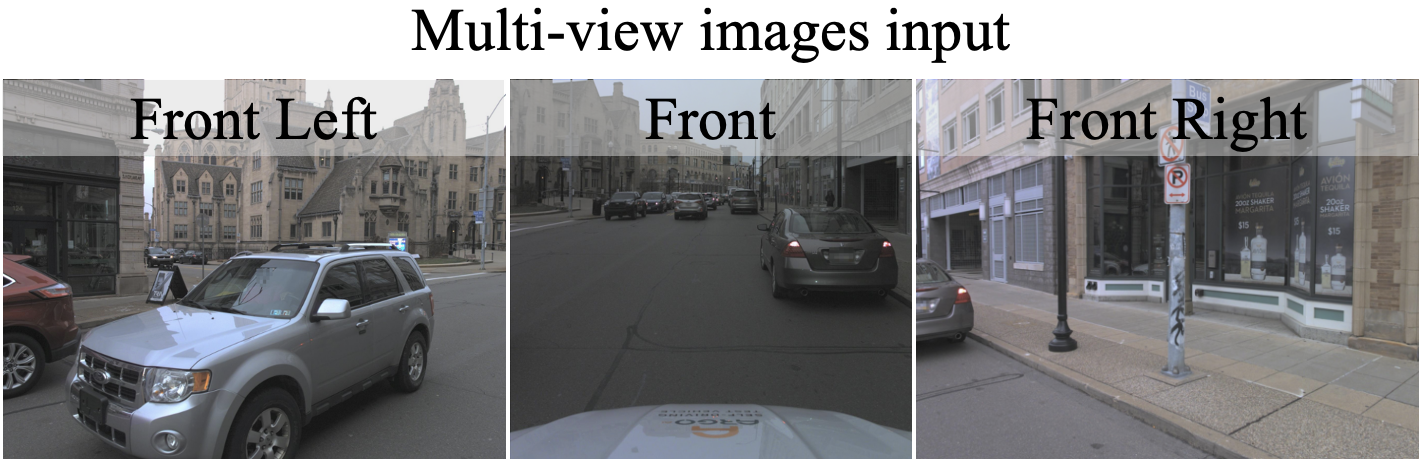
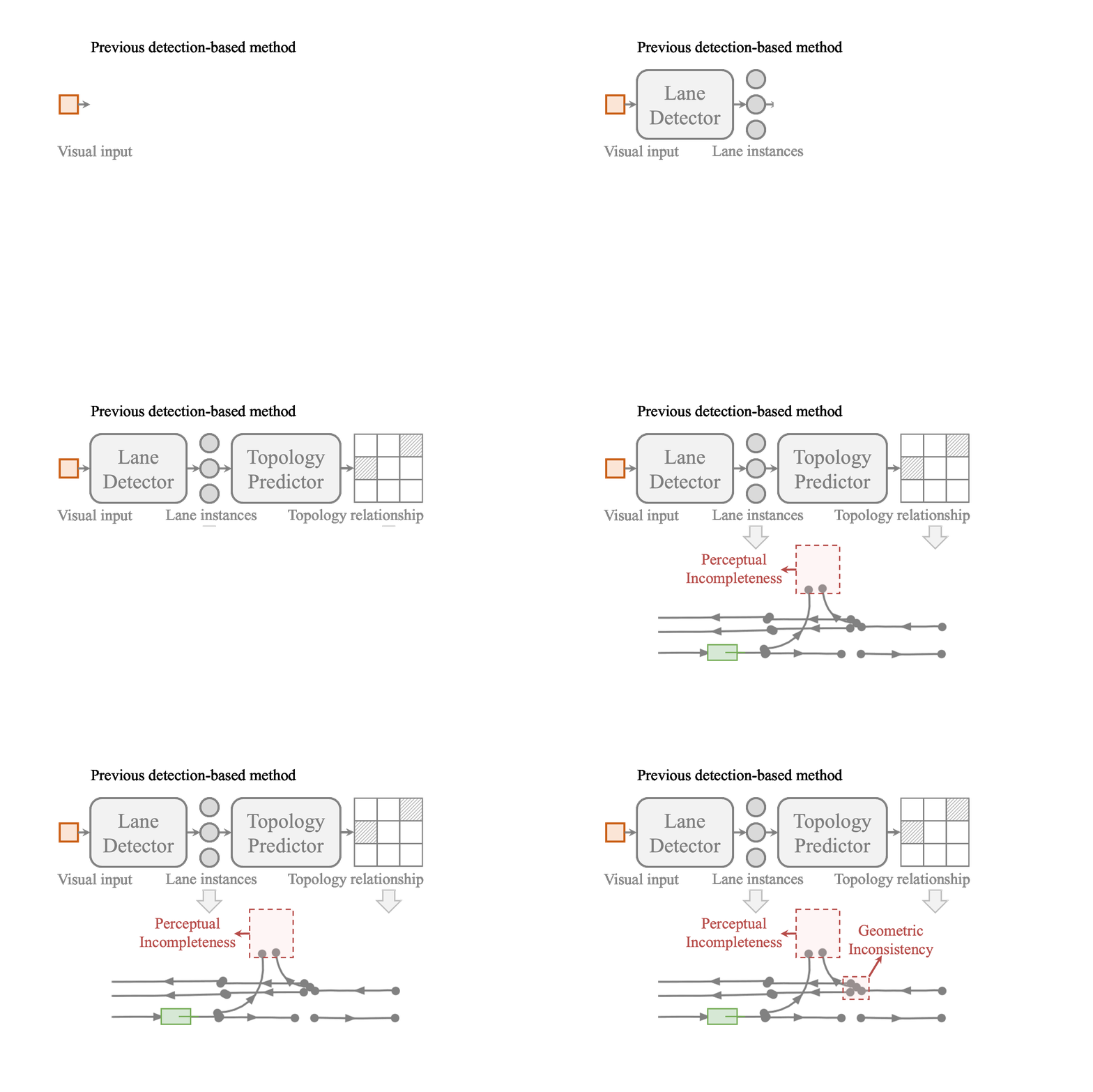

TopoGPT uses an Autoregressive Lane Sequence Transformer to model lane graphs as token sequences. A two-stage training strategy first learns road-geometry regularities from map data, then transfers that prior to perception-conditioned lane graph prediction.
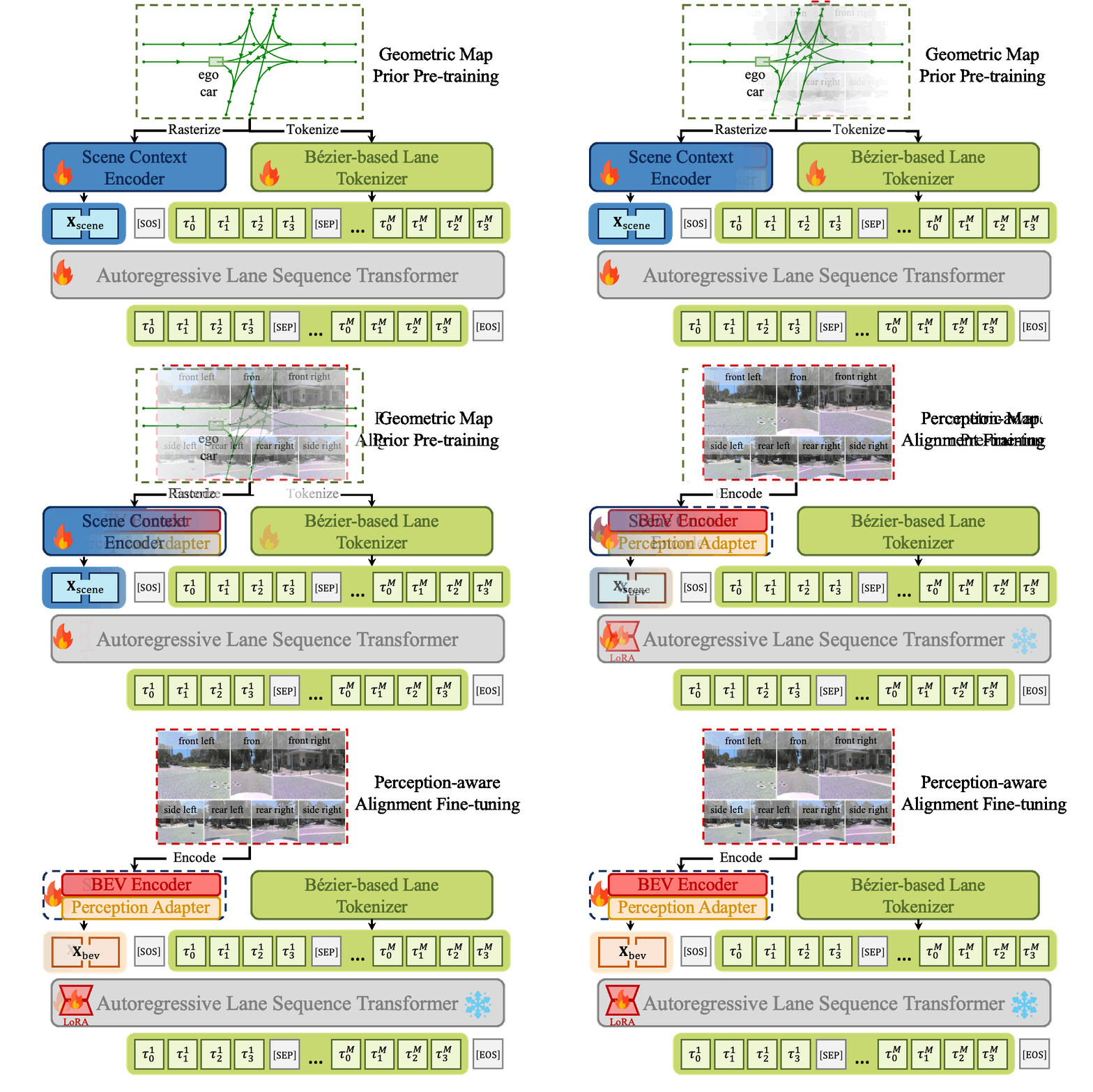
Learn a geometry prior by autoregressively generating lane token sequences from large-scale map-derived scene tokens.
Align BEV perception tokens to the scene-token space so the pre-trained generator predicts realistic lane graphs from multi-view images.
Unlike image-map paired data, which requires strict spatial and temporal alignment, map-only data can be collected at much larger scale from offline maps. We gather 3.3M map scenes from multiple motion datasets and convert heterogeneous map annotations into a unified lane-token representation.
On OpenLane-V2, TopoGPT improves both lane-level matching and point-level graph quality. The four bar charts below report all lane metrics and graph metrics on subset A and subset B.
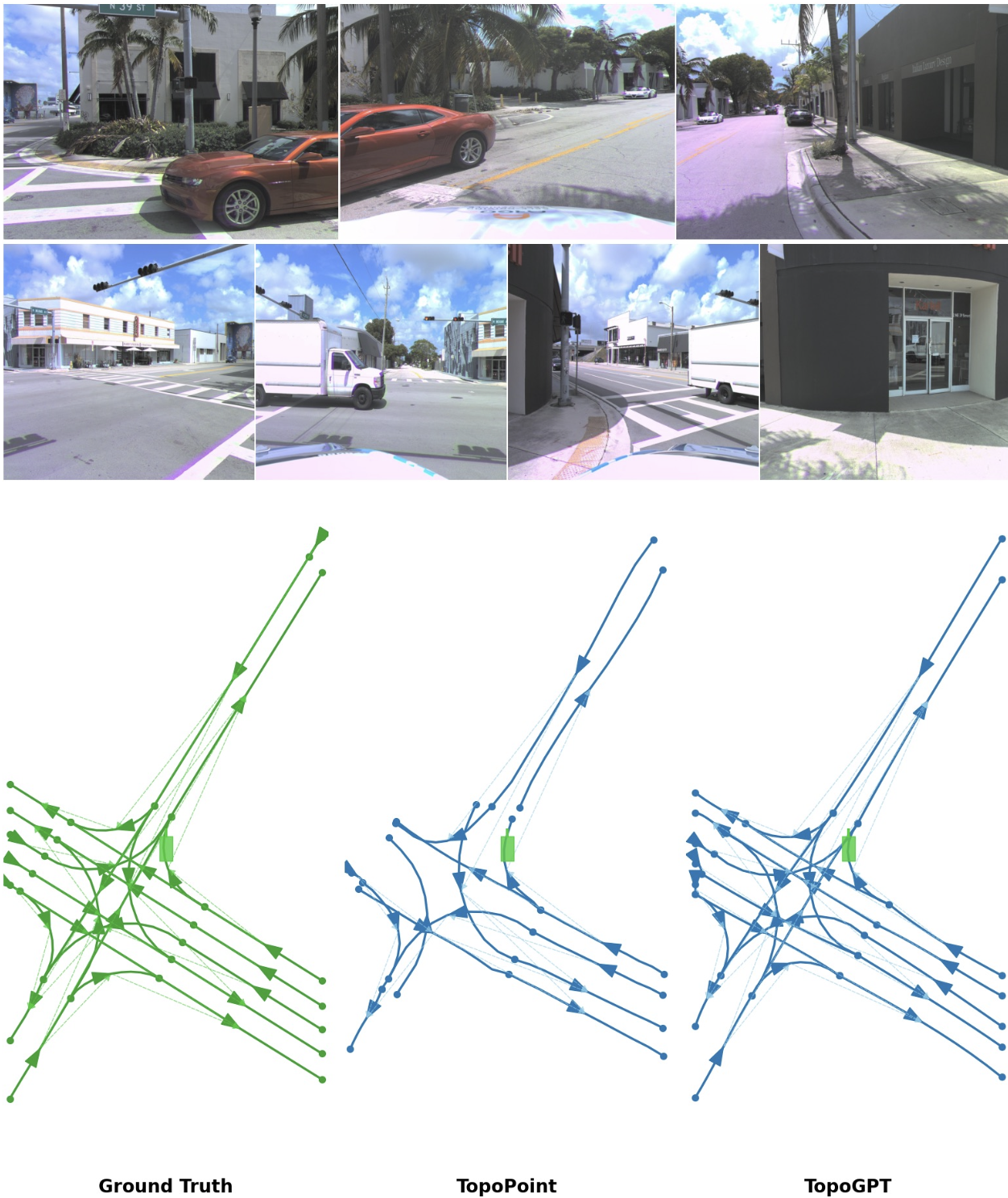
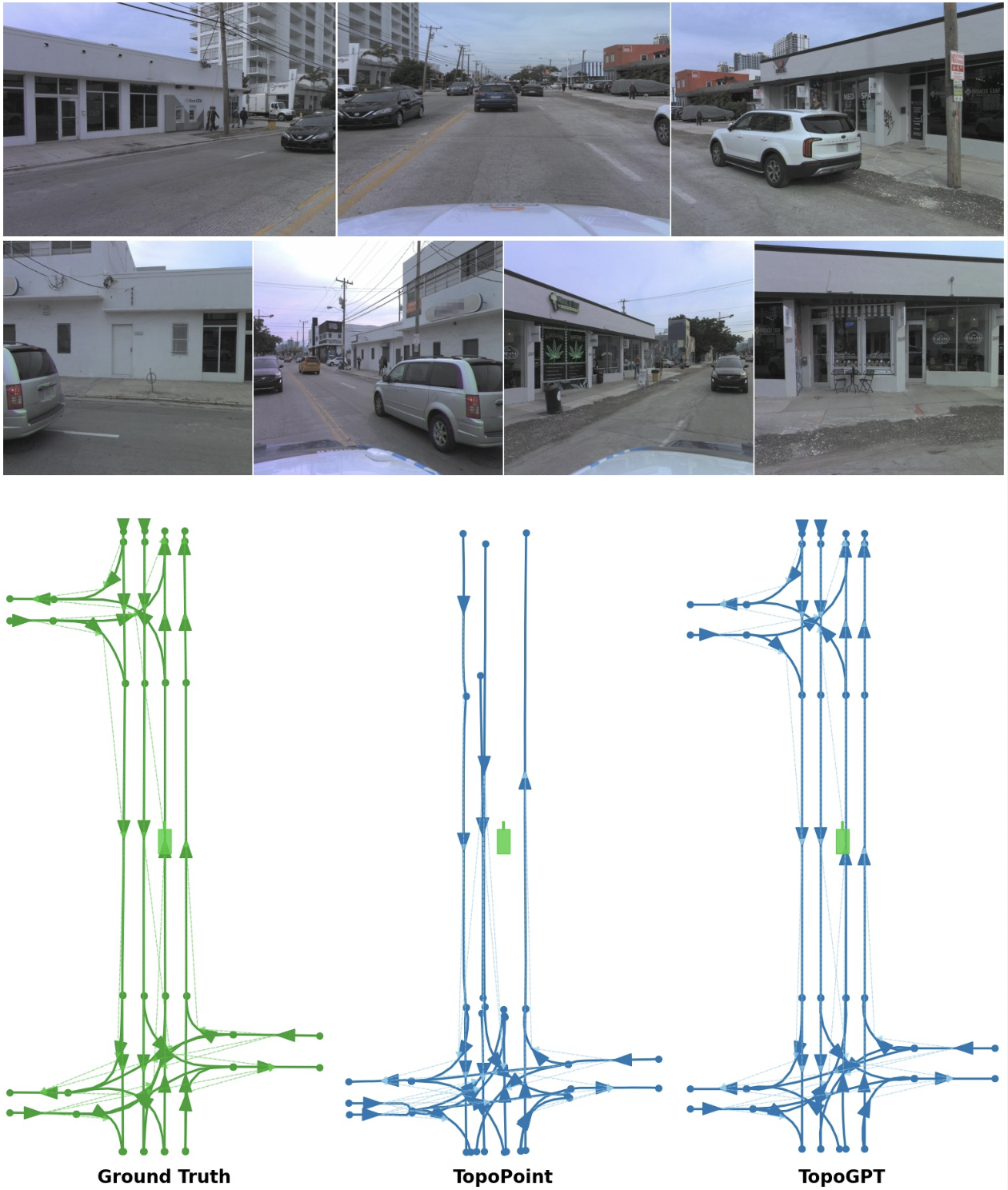
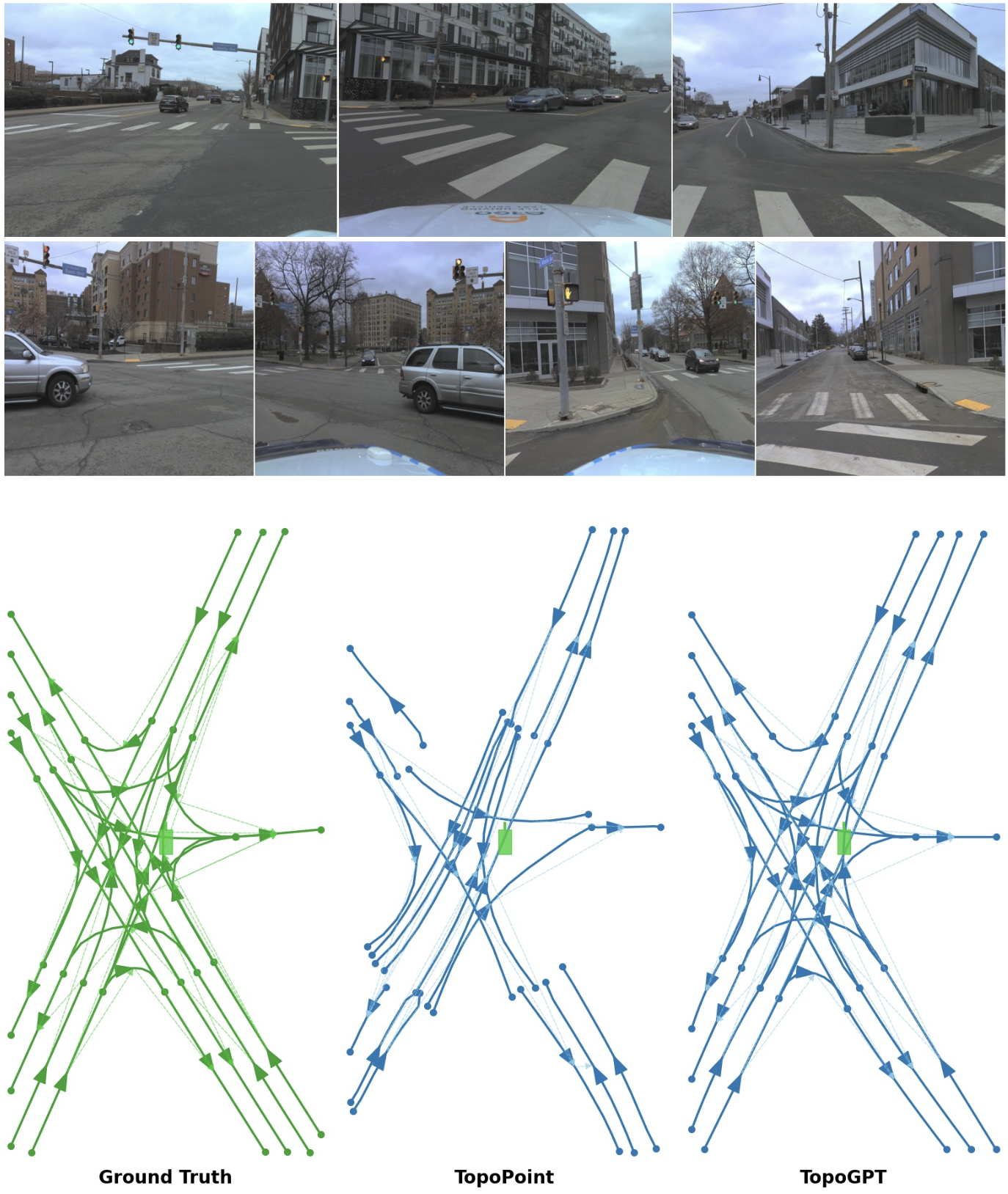
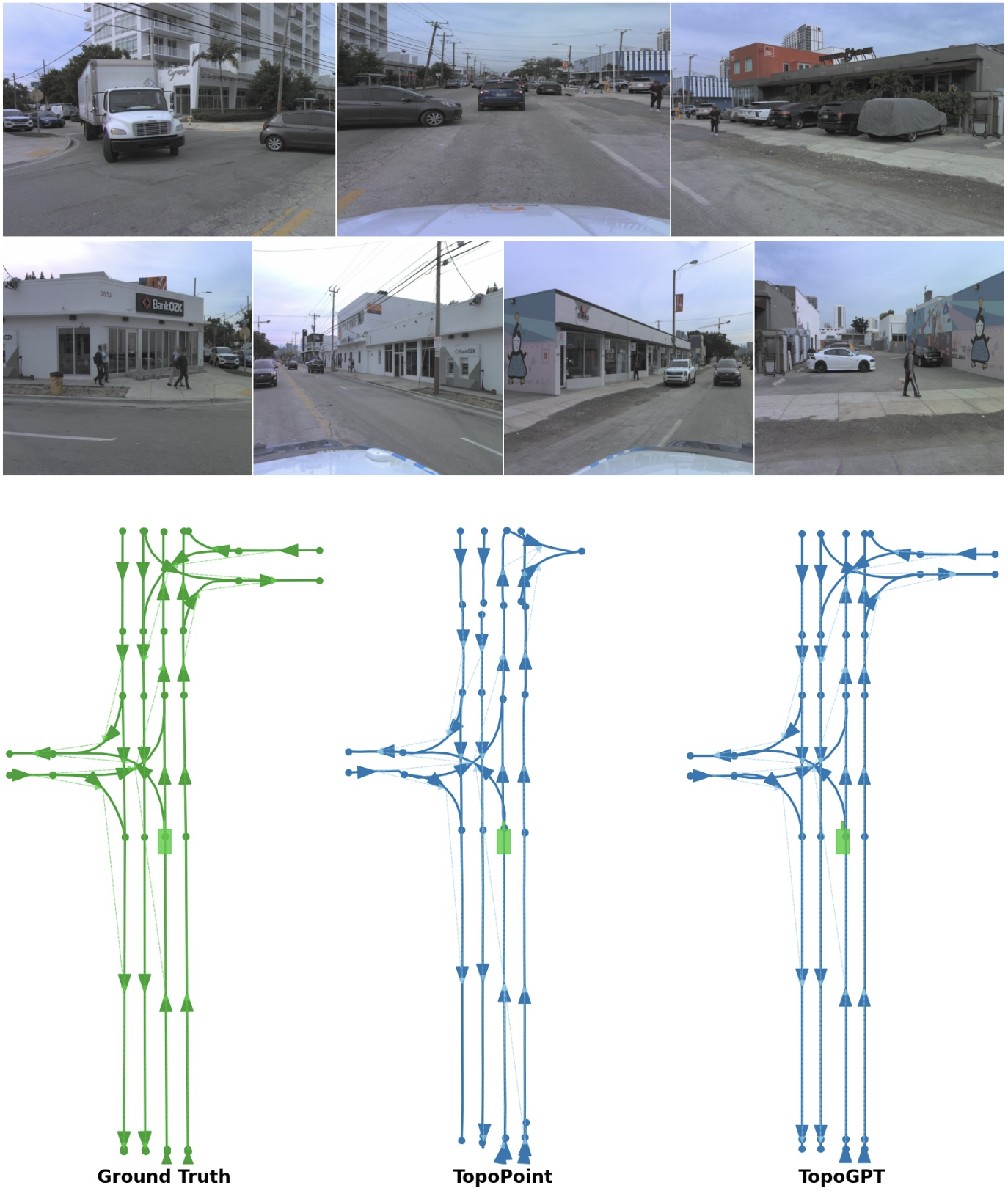
Representative TopoGPT predictions visualize camera-conditioned lane graphs across diverse scenes.
Please cite our paper if TopoGPT is useful for your research.
@inproceedings{fu2026topogpt,
  title={Generative Lane Topology Reasoning via Autoregressive Model with Geometry Prior},
  author={Fu, Jiahui and Huang, Zehao and Li, Han and Wang, Naiyan and Liu, Si},
  booktitle={European Conference on Computer Vision},
  year={2026},
}